Author website examples: what the best ones include
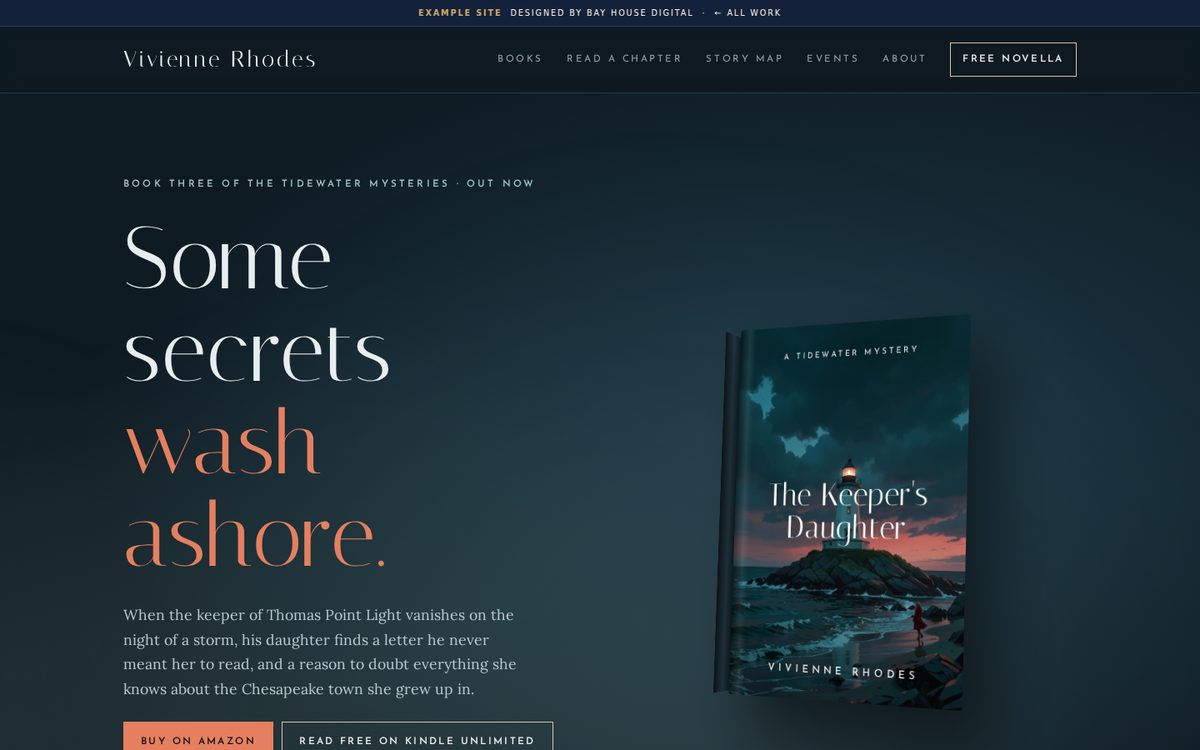
The strongest author websites have one thing in common: they are built around the books and the reader, not the author's biography. The latest book is front and centre, the reading order is impossible to miss, there is a reason to join the mailing list, and every book links straight to the stores. Beyond that, most good author sites take one of five forms.
If you are still deciding whether you need a site at all, start with Do self-published authors need a website if they sell on Amazon?
1. The series hub
For authors of a series, the website's most important job is answering one question: "which book do I read first?" The best series sites have a clear reading-order page, a page for each book with its cover, a short description and buy links, and a home page that leads with book one, not the latest release.
What to borrow: a numbered reading order, repeated on every book page.
2. The single-book launch site
Around a big release, some authors give one book its own page or site: the cover large, a strong opening line, early praise from named sources, a sample chapter and pre-order buttons. After launch, it folds back into the main author site.
What to borrow: a sample chapter. Letting readers start the book on your site is a better pitch than any description.
3. The author-as-brand site
Some authors are the draw, more than any single book. Their sites lead with the author: a strong portrait, a clear statement of what they write, then the books. This suits non-fiction authors, speakers, and novelists with a distinctive voice or public profile.
What to borrow: one sentence that says what kind of books you write, so a new visitor knows in seconds whether they are your reader.
4. The newsletter-first site
For many self-published authors, the mailing list is the business. Their sites are built to turn visitors into subscribers: a free short story, novella or bonus chapter offered on the home page, at the end of every book page and in the back of every book.
What to borrow: a reader gift that genuinely belongs to your books, and a welcome email series that introduces you and your world.
5. The debut author's site
With one book, the site can be simple: the book, the author, a sign-up, a way to get in touch. The best debut sites look as considered as an established author's, because the website is often the first thing a reader, bookseller or reporter checks.
What to borrow: restraint. Three well-made pages beat ten thin ones.
What every strong author website includes
| Page or feature | Why it matters |
|---|---|
| Latest book on the home page | Returning readers come looking for it |
| Books page with reading order | Answers the question series readers always ask |
| Buy links for every format | Ebook, paperback and audiobook, in each store you sell in |
| Newsletter sign-up with a free gift | The one direct line to readers you own |
| About page with a real photograph | Readers like to know who wrote the book |
| Media page | A short biography, photographs and contact details for press |
Keep your Amazon author page, managed through Author Central, consistent with your website: the same photograph, the same biography and links that point back to your site. And build the site so every reader can use it, following the W3C's WCAG 2.2: readable type, good contrast and real text rather than words baked into images.
Where Bay House fits
Every Become an Author package includes an author website built around your books. Essentials, from $10,000, covers the novel written with you and AI, publishing on Amazon and the website. Author Studio, from $25,000, adds an AI-assisted mailing list with a welcome series and new-release emails. Author Platform, up to $50,000, adds two social platforms, a launch campaign, Amazon promotion and ongoing support. See our pricing, and for how paid services compare, read Full-service author package or hiring separately?
Common questions
What pages should an author website have?
A home page featuring the latest book, a books page with every title and its reading order, an about page, a newsletter sign-up with a free reader gift, a contact or media page and links to every store.
Should an author website have a blog?
Only if you will keep it up and it serves readers. A newsletter usually does more for an author than a blog, because it reaches readers directly.
Do I need a separate website for each book?
Usually not. One author website with a page for each book is easier to keep current and builds one audience. A separate page or site can make sense for a big launch.